
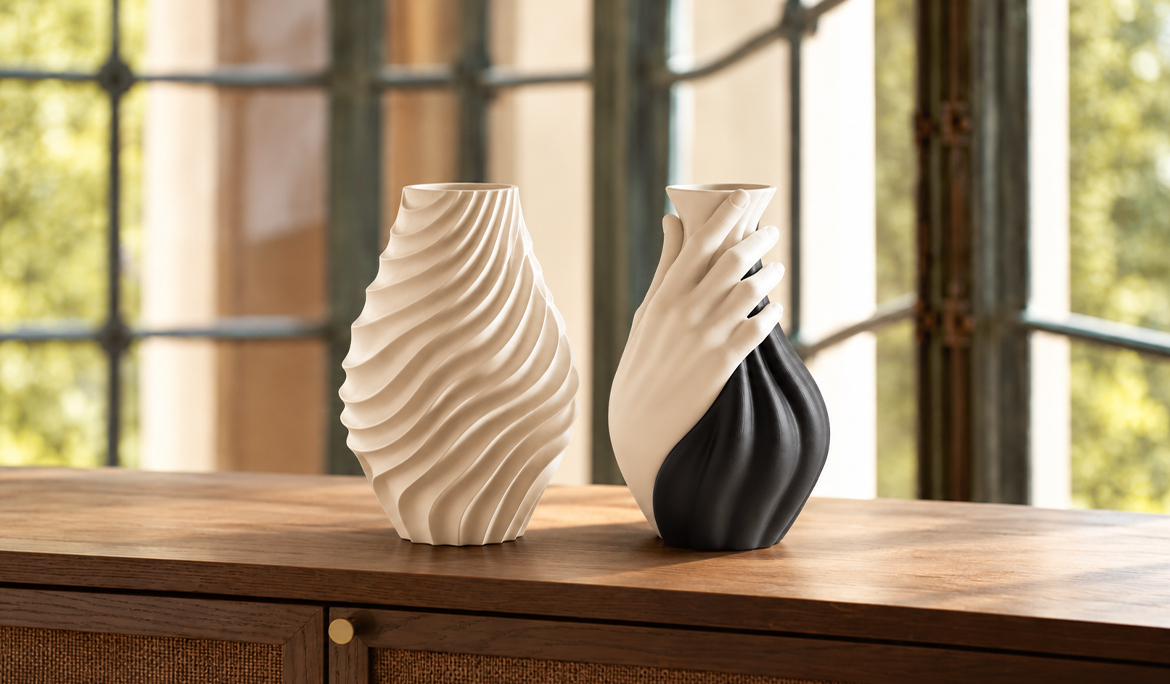
Place two identical vases beside each other and the arrangement can feel formal, balanced, and predictable. Add a third object with a different height or shape, and suddenly something changes. Your eyes begin moving around the arrangement rather than simply dividing it in half.
This is the odd-number effect at work.
Groups of three appear frequently in decorating because they can create balance without becoming overly symmetrical. But the idea is more useful than simply counting objects. Height, shape, spacing, texture, color, and visual weight determine whether a trio feels thoughtfully arranged or resembles three unrelated things waiting for somewhere else to go.
Even-numbered arrangements naturally encourage pairing. When two objects sit together, your brain quickly understands the relationship: object one, object two. With four objects, you may instinctively divide them into two pairs.
Odd numbers interrupt that easy division. With three objects, there is usually a center and two supporting elements, or a visual triangle connecting the pieces. This creates enough structure to feel organized while maintaining slight asymmetry.
That asymmetry can make an arrangement more engaging. Instead of absorbing everything immediately, the eye moves between individual elements. One object may attract attention first, another provides contrast, and the third completes the composition. The result can feel balanced without appearing rigid.
Why three rather than five, seven, or nine? Larger odd-numbered collections can certainly work, but three provides a particularly useful middle ground. One object can look isolated. Two can look paired. Three can look composed.
A trio introduces enough variety to create a miniature arrangement without requiring a large amount of surface space. This makes groups of three especially practical on consoles, coffee tables, shelves, bedside tables, dining surfaces, and other display areas. You have enough objects to experiment with height and texture while still keeping the arrangement visually readable.
The odd-number effect does not mean buying three identical decorative objects. In fact, excessive matching can weaken the effect. Imagine three identical vases lined up at equal distances. The result might be neat, but your eye processes them nearly as a repeated pattern rather than an interesting composition.
Now change the heights. Perhaps one is tall and narrow, another medium and rounded, and the third short and wide. Suddenly, the eye has more information to explore. Variation creates rhythm.
The objects can still share something in common, such as material, color family, texture, or general style. That shared feature creates cohesion while differences prevent the arrangement from becoming monotonous. Think related, not cloned.
Height is one of the easiest ways to make a three-object arrangement work. Try combining tall, medium, and low elements. A tall vase might provide the vertical anchor. A medium decorative object can occupy the middle level. A low bowl or tray can finish the grouping closer to the surface.
This creates a loose triangular composition. The eye naturally moves up, down, and across instead of encountering one flat horizontal line. You do not need mathematically precise height differences. In fact, slightly irregular proportions often feel more relaxed. If two objects are naturally similar in height, you can elevate one using a book or small platform.
Decorating sometimes involves giving an object a tiny stage.
Shape is another useful ingredient. Three round objects can work, particularly if their sizes differ, but combining contrasting forms often creates more visual energy. Try pairing something tall and cylindrical with something curved and something flatter or angular.
The contrast makes each silhouette easier to distinguish. This is particularly useful when the objects share similar colors. If everything belongs to the same tonal family, shape variation prevents the arrangement from visually blending into one indistinct cluster.
Conversely, if your objects already contain strong color variation, keeping their shapes relatively simple can prevent the grouping from becoming overly busy. Balance one type of variation with another.
Sometimes three objects have completely different shapes but still need to feel connected. Texture can become the bridge. A smooth vase, textured sculpture, and woven container might seem unrelated individually. But if their colors and proportions complement one another, their contrasting surfaces can become the defining feature of the arrangement.
You can also repeat one material. Perhaps two objects contain ceramic surfaces while the third introduces wood. Or two pieces have matte finishes while one adds subtle reflection. The goal is not uniformity. You are looking for enough repetition to establish a relationship and enough contrast to keep that relationship interesting.
Three attractive objects pushed tightly together can become one confusing visual mass. Move them too far apart and they quit feeling like a group. Spacing determines whether the eye reads the pieces as connected. Try placing the objects relatively close while allowing enough room for their individual silhouettes to remain visible.
They do not necessarily need to sit in a straight line. On deeper surfaces, positioning one item slightly forward and another farther back can create depth. This works particularly well on coffee tables, deep shelves, and consoles. Think of the arrangement as occupying three dimensions rather than simply decorating a horizontal strip.
Groups of three are not limited to vases and sculptures. The same principle can be applied throughout a room. Three cushions can create a relaxed grouping on a sofa. Three framed pieces can establish a compact wall arrangement. Three pendant forms can create repetition above a surface. Three objects positioned across shelving can establish a recurring visual rhythm.
You can even think in terms of three larger categories rather than three individual objects. A reading corner might contain a chair, lamp, and small table. Together, those elements form a functional and visual grouping. The odd-number principle can therefore influence entire areas, not merely decorative accessories.
The rule is useful, but it is not universal. A tiny side table may simply not have enough room for three objects. Trying to force a trio onto it can create clutter and interfere with practical use. Similarly, one sculptural object with strong visual presence may already provide everything the surface needs.
Context always matters more than formulas. If three objects block access, crowd a surface, compete with nearby decorations, or make the arrangement difficult to understand, reduce the number. A decorating principle should solve visual problems, not create new ones.
Larger odd-number groupings can work particularly well on wide surfaces or open shelving. However, as the number increases, organization becomes more important. Five separate objects scattered randomly across a console may feel chaotic. Instead, consider creating smaller relationships within the larger collection.
Two objects might sit close together while three form another cluster, with the entire arrangement connected through color or material. With seven objects, variations in height and spacing become even more important. The underlying principle remains the same: avoid making the arrangement so uniform that it feels mechanical or so varied that it loses coherence.
Once people discover the odd-number effect, there is a temptation to apply it everywhere.
Eventually, the room begins revealing the formula. Good decorating benefits from variation. Some areas may contain one strong object. Others might use pairs for deliberate symmetry. Another surface may feature a trio.
Changing the rhythm across a room makes individual arrangements feel more natural. Use three when it helps, not because you think the decorating police are counting.
When creating a trio, evaluate three things: hierarchy, connection, and breathing room. First, determine whether one object naturally attracts attention. A slight hierarchy gives the eye somewhere to begin.
Second, identify what connects the pieces. It might be color, material, shape, theme, or texture. Third, examine the spacing. Each item should remain visually identifiable while still feeling part of the same arrangement.
Then step away. View the grouping from the position where you normally see it. Sometimes an arrangement that looks wonderful from twenty centimeters away becomes strangely flat from across the room. Distance reveals composition.
The odd-number effect works because it offers an appealing mixture of structure and irregularity. Groups of three can create movement, establish hierarchy, introduce variation, and make decorative arrangements feel composed without requiring ideal symmetry.
But the number alone does not create the effect. Three badly scaled objects are still badly scaled objects. Successful arrangements depend on how the pieces communicate through height, shape, texture, color, visual weight, and spacing.
So the next time a shelf or table looks slightly unfinished, try adding or rearranging a third element. Not because three is a secret decorating number. Because sometimes the eye enjoys a composition that refuses to split neatly in half.